Sunday, June 26, 2022

The Mermaid Chronicles - Part Three: The Sea Bar

The Sea Bar: Mermaid Spirits
Mermaid Water:
Blue Curacao - 20 ml.
Vodka - 20 ml.
Grapefruit juice - 20 ml.
Pineapple juice - 20 ml.
Lemon - 10 ml.
a splash of sprite
The Shipwreck:
8 oz. V-8 juice
1 oz. lime juice
Dash of salt and pepper
Dash of Worcestershire sauce
Dash Tabasco sauce
1 oz. vodka (optional)
Pour over ice into a lime and salt rimmed glass with one thin celery stick.

Sex on the Beach:
1 part vodka
1 part raspberry liqueur
1 part melon liqueur

Seabreeze:
1 1/2 oz. vodka
4 oz. cranberry juice
1 oz. grapefruit juice
1 wedge of lime
Seaside Punch:
2 quarts cranberry cocktail
1 quart orange juice
6 oz. citrus vodka
6 oz. Brandy
2 oz. lime juice
Combine all ingredients in a gallon marked container. Add enough ice to bring the volume up to one gallon. Stir and pour into a punch bowl. Garnish with orange and lime slices. Serves approximately 24 people.

Dry Mermaid Martini (Mertini?):
4 oz. Gin
1 oz. Cherry Brandy
2 lemon wedges

Swimming Pool:
1 scoop ice, crushed
1/4 oz. cream, sweet
3/4 oz. coconut cream
2 oz. pineapple juice
3/4 oz. vodka
1 1/2 oz. rum, light
1/4 oz. Blue Curacao

Blue Dolphin:
2 oz. Vermouth
1/2 oz. Blue Curacao
Dash Grenadine
Lemonade
Slice of lemon
Ice
To a tall glass full of ice, add vermouth and Blue Curacao then stir. Top up with lemonade. Add a drop of grenadine. Garish with lemon slice.
(Reference: Mermaid.Net: Where the sirens scream)
Saturday, June 25, 2022
The Mermaid Chronicles - Part Two: Mermaid Species
Are mermaids real? Oh yes, they are quite real. There are so many different types of mermaids the average human would be quite surprised. But, I as well was also surprised when I found so many of my kind on the internet. It seems like many artists, photographers, scientists, and mermaid enthusiasts were not to far from the truth when they spoke or drew about mermaids. Although this page will be referring to merfolk in general, the term "mermaid" will be mostly used to signify the entire species because if the majority of merfolk popularity revolves around the females.
This portion of The Mermaid's Lagoon will educate users about the different species of mermaid. This document is a brief outline of all the known mermaid species in the world. When the term "known" is used, this refers to all the previously documented, photographed, artistically rendered or witnessed species in the world, under the scientific name "Sirenius".
Asian (Haitian) Mermaid
Sirenius Hindusexei

Also referred to as the "Haitian" mermaid in eastern waters, this mermaid species has been seen in the southern Caribbean sea, in and around Hawaii, and most of all in the far western Pacific and Northern Indian oceans, off the coast of Southern China, Malaysia, Indonesia, and Northern India. This mermaid's origin is speculated to come from Asian/Polynesian descent due to the common facial features. Her nether portion is deep vibrant orange or golden red, with large visible scales all the way down to her two fluked tail. These mermaids do not have any vocal cords, but have a complex sign language based on tail and other body movements.
Butterfly Mermaid
Sirenius Pletfagigantus

The Butterfly mermaid is more temperate than other mermaids, living only off the coast of southern Japan in relatively cool waters. These mermaids are comprised entirely of females making them one of the first single-sex species, using the same sex couples to procreate. There have been many different sub-species including a catfish-like species so it has not been confirmed the exact number of differences there are. All mermaids have specific colored spots and patterns on both their nether and back area, indicating house and status. These mermaids are quite intelligent, but are ignorant to human civilization. They live and interact in village groups with the ruling mermaid wearing the proudest pattern.
Cagle Mermaid
Sirenius Cagliusii

The Cagle mermaid is similar to the Green mermaid, but because of more human characteristics the species has it's own genus. Some of their characteristics include human genitalia, the scale merging beginning below the thighs, and more human-like behavior patterns compared to others. Because of their great similarities to humans, males find them irresistible when encountered. Cagle mermaids like to adorn themselves with jewelry when found and love to taunt sailors and male swimmers while out at sea. Their tails are mostly green in color, but some teal and blue Cagles have been spotted. Found in almost all warm waters of the both oceans, they seem to be very prolific travelers - from being spotted off of the coast of Hawaii to areas the Great Barrier Reef. Discovered by artist Kurt Cagle, who has drawn and photographed many of these mermaids.
Caribbean Mermaid
Sirenius Mammalius

One of the most exquisite species of them all, Caribbean mermaids are one of the most alluring, beautiful creatures in the world. As the name implies, these mermaids were first discovered in the Caribbean, but can be found as north as Cape Cod in north-eastern United States or as south as Venezuela. The most stunning characteristic is their dark vibrant red tail, usually patterned with golden streaks outlining the curvatures of the mermaid's pectoral and ventral fins and lower torso. These mermaids are known for their large two-fluked blackened tails, long blonde thick hair, and round firm large breasts. They can create breathable atmosphere for humans under water by ejecting special acids and fluids into a person's mouth via the lips. These mermaids are also known for their sexual allure and like to play and tempt males of their kind. Only recently they were exposed to mankind.
Fantail Mermaid
Sirenius Kaudlacolare

The Fantail mermaids consider themselves to be the royalty of the sea. Although they only occupy a fairly small amount of territory, just a few portions of the Great Barrier Reef, they present themselves as the highest and most intelligent species in the ocean. These are the most naïve of all mermaids, believing that they have the perfect society ruled by a single monarchy, the Queen, in their beautifully constructed coral castles. No human or any other merfolk has ever been very far into their territory - scuba divers are driven out by force or by seduction, whichever the mermaid guards wish. The male fantails are the minority, but only by a small percentage. Their society is based on female superiority. The origins of this species are unknown.
Freshwater Mermaid
Sirenius (Nympha) Pisciformosa

The Freshwater mermaid lives in the lakes and rivers of the British Isles, northern Europe and the Caspian Sea. Their known characteristics are silvery scaly tails, similar to salmon, and a dual fluked or veined caudal fin. It is said to have a talent for healing. Diseased fish are reputed to be very quickly healed merely by contact with its' skin. These mermaids are elusive enough to trick many by mimicking the color change and pallor of death. When the danger has passed, which has led to the belief that this species can rise from the dead. Unfortunately, these characteristics have rendered them desirable - the scales are highly prized amulets. These mermaids live separate from the males and only mate twice a year when they swim out of sea.
Green Mermaid
Sirenius Sirenius
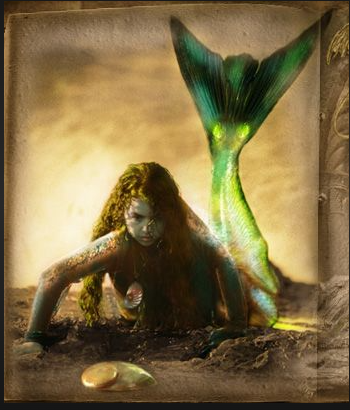
Long hair, dazzling eyes, full round breasts, and the sudden transition from golden skin to green scales is the most common description of a typical mermaid. Known before as just a "mermaid", Green mermaids are probably the most widely known sirens seen throughout all the major bodies of water. There has been much decline in sightings of these mermaids, probably due to the fact of the industrialization of society over the last century. Green mermaids have a society similar to the human monarchy where the mermen (more commonly known as "tritons") have majority and control over the society. Many variations have been observed over the centuries - mermaids with long tails, transitional membranes, scaled fins, even some with two tails like the French mermaid Melusine. Many fairy tales and folklore are based on Green mermaids - probably the most famous one being Disney's "The Little Mermaid" Ariel.
Indo-Pacific (Skin) Mermaid
Sirenius Epidermius

"Skin" mermaids are nature's irony. The most human-like mermaids on the outside, yet the most unhuman-like on the inside. These mermaids are entirely covered with skin all the way down to their fluked tail. Indo-Pacific merfolk live where their name implies: Indian and Pacific oceans. These merfolk are quite commonly found in every part of the Pacific ocean and most of the Indian, producing conflict with other mermaid species - mostly the Fantail. The Indo-Pacific are the most intelligent mermaid species - having the largest brain size out of all merfolk, even larger than humans. This large cranium seems to indicate the presence of telepathy where merfolk can communicate over short distances with others. Skin mermaids are serious naturalists living as they always have without any inventions or technology, with only themselves and the sea. Their entire way of life is based around sexual exploration where a mermaid can give birth to up to 8 merfry in four months! It is surprising how much is known about this species because they are very shy and rarely surface.
Pearl Mermaid
Sirenius Perwoscentia (Delphinus)

Known as the "Pearl of the Sea", these mermaids are considered to be one of the most beautiful and wonderful creatures that live today. These quiet, subtle, passionate creatures live scattered among the Oceana, but have been spotted as north as Hawaii. These mermaids are recognized by their smooth, pearlish hue faded from their skin tone, and a smaller caudal fin. Fertile females protrude a darker ridge on their dorsal, which extended down to the tail. Violet colored variations have also been seen with a slightly larger more Delphine tail known under the subspecies Delphinus. Although no mermen have been seen, it has been observed that the females have a tendency to go out and explore the ocean - usually leaving their male companions in the deep. On rare occasions they have interacted with humans, but somehow photographer Jason Gold has managed to capture the greatest mermaid photos of all time from this species.
.jpg)
Friday, June 24, 2022
The Mermaid Chronicles - Part One: Introduction

Back in 1998, I began a collection of articles which I had found while searching on the internet. It was about the time when AOL was popular and we had just gotten our first computer in my old apartment. It wasn't long before I got hooked on searching every single mermaid website that I could find! I searched for poetry, artwork, recipes, and literally anything and eveything that I could find on the subject of MERMAIDS!
I found so much information that I began printing off dozens of pages so that I could read them as I found the time to do so. The following is a series of posts from those pages that I would like to share with all of you.
I hope that you enjoy them as much as I have!
Sunday, June 19, 2022
The Anatomy of a Mermaid

Anatomy Of A Mermaid
(“Mermaid Anatomy" - A scientific outlook)
Contrary to popular belief, mermaids are not human or fish at all. They are mammals with the appearance of a human being above the pelvis and the appearance of dolphins or whales below. All mammals are warm-blooded and have hair, and all female mammals have mammary glands (breast and nipples for feeding young). Fish have a completely different anatomy. Mermaids do appear to have scales, but it is possible that this is in fact a pattern or camouflage that resemble scales. Some species of mermaid also have twin-tails and there are even some that are completely humanoid in appearance, apart from scale-like skin and dolphin-like biology (sonar, respiratory, circulatory and skeletal systems). The mermaid is also known to have both a Caucasian or negro complexion and some sightly have a greenish appearance.


Biological functions
Mermaids have organs in their chest that can operate as a lung or a gill, depending on whether they are in or out of the water. The organ expands and contracts exactly like a lung, yet has the ability to extract oxygen from the water. This allows the mermaid to ‘breathe’ water in the same way that they breathe air - by filling and evacuating the chest cavity. This organ is also needed to operate the larynx. The human larynx cannot operate under the water as it cannot be made to vibrate from water pressure, yet the mermaids larynx operates equally well using water or air. The mermaid circulatory system is also designed to withstand differing water pressures like that of the dolphin and whale, while the skeleton is light and pliable like those of a bird or dolphin. The lenses of mermaid eyes are also different and are able to correctly focus for use both above and under water. A mermaid is also able to hear on a different level to humans and has the ability to use sonar for communication and hunting purposes underwater.
Reproduction
In mermaids, reproduction is much like that of dolphins. The reproductive organs of both the male and female are akin to the dolphin and whale, and mermaid babies are born live (as opposed to hatched from eggs).

Females have human internal reproduction organs; however the vagina is slightly shorter, and the common urogenital opening (the urethra merges with the vaginal canal near the opening) is at the front. The opening can stretch as much as a human vaginal opening; mermaid babies are born live. A clitoris (which is the same color as the tail) is slightly below the urogenital opening, and an anus is above the urogenital opening. Mermaid vaginas are slightly smaller than human ones (since merman penises are smaller, explained below), so they tend to be more sexually satisfying to human males.
Males do have a penis, but it is almost as small as a human female clitoris and is the same color as the tail; it is hardly visible (this is the only plausible explanation to why no one has ever seen a penis on any of merman). It is used for urination, as well as sexual intercourse. The testicles are inside the tail, as opposed to the pelvis, since they require a slightly lower temperature to function properly (the human and pelvis part is warm-blooded, but the tail is cold-blooded). The anus is above the penis.
Diet
The mermaid mostly eats fish, but has been known to subsist on other meats, fruits and vegetables. There are some species of mermaid that are vegetarians only.
Habitat
The mermaid is able to exist equally on land and in the sea, although it can become dehydrated if on land for extended periods of time. Most mermaids live in schools or pods, but some are known to travel as hermits. They can live in caverns below the sea and in undersea cities. The merpeople cities is more common on other planets, but in the future there will be build bigger merpeople cities on Earth. Some of the merpeople are more advanced technological and spiritual than Earth human and is several thousand years ahead. They have free energy, teleportation, interstellar space travelling etc. Some of the merpeople live on big space stations and on starships.”
 "Minerva"~ The Roman goddess of wisdom and science.
 (Reference: https://mysticmerangel.tumblr.com/post/114814202014/anatomy-of-a-mermaid-mermaid-anatomy-a)
For more info, see the Kindle book, The Anatomy of A Mermaid on Amazon.com at http://www.amazon.com/The-Anatomy-Mermaid-Tom-Ryerson-ebook/dp/B0097JWU
Friday, June 3, 2022
From the Treasure Chest
Greetings fellow mermaid enthusiasts! Here are a few more additions to the treasure chest!
A Dollar Store find - a mermaid sign ...

A gift from hubby ...


HAPPY TREASURE HUNTING EVERYONE!!
Sunday, May 8, 2022
Happy Mother's Day!

🐟🐳🐬🐠🐡🐟🐳🐬🐠🐡🐟🐳🐬🐠🐡
The Mermaid
Say not the mermaid is a myth,
I knew one once named Mrs. Smith
She stood while playing cards and knitting,
Mermaids are not equipped for sitting
~ by Ogden Nash
Undersea
Beneath the waters green and cool
The merfolk keep a swimming school,
The oysters trot, the lobsters prance
The dolphins come to join the dance,
But the jellyfish who are rather small
Can't seem to learn the steps at all
~ by Marchette Chute

Subscribe to:
Posts (Atom)